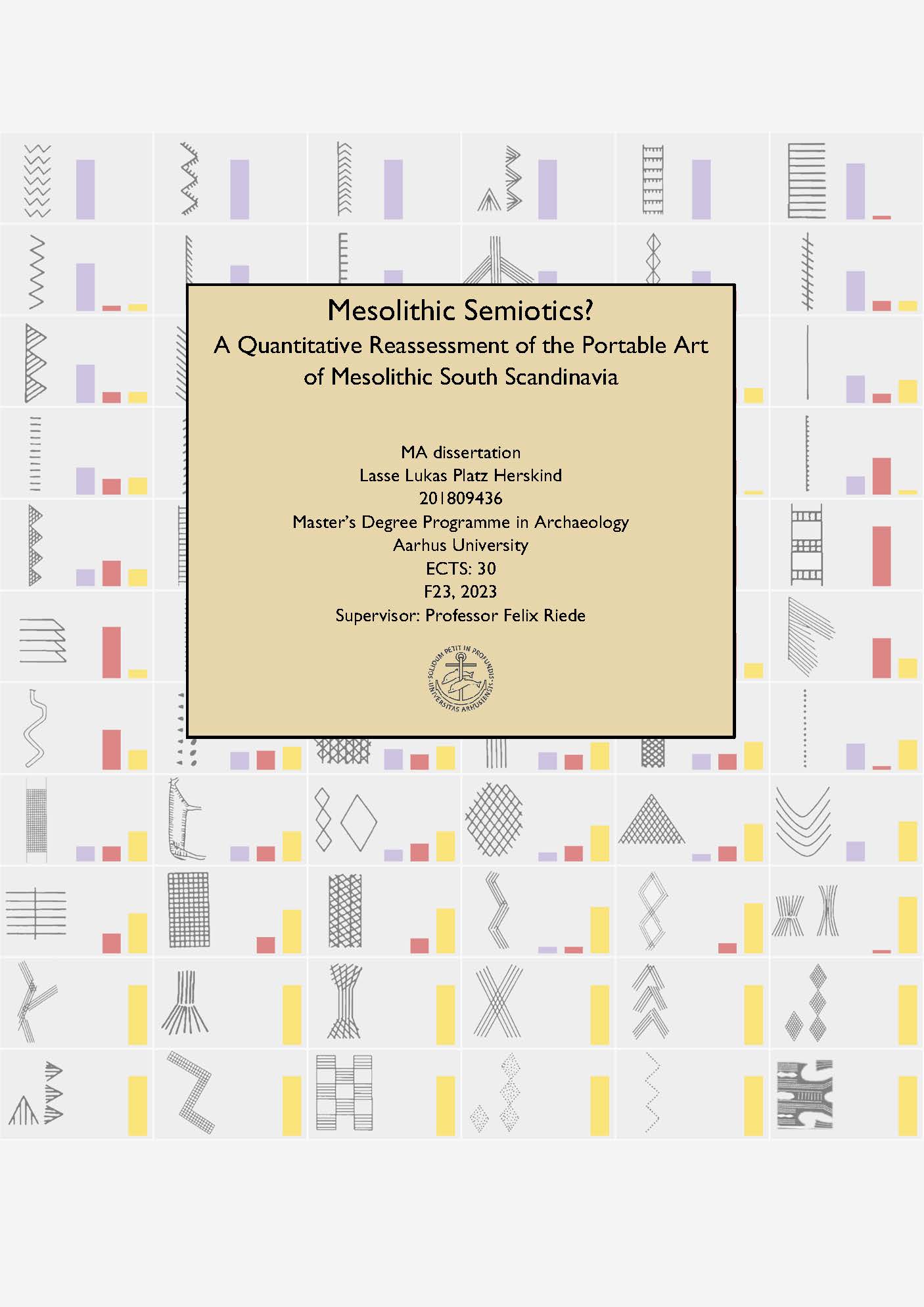
Af Lasse Lukas Platz Herskind
MA dissertation, july 2023
Master’s Degree Programme in Archaeology
Aarhus University
Supervisor: Professor Felix Riede
Abstract
Through a methodologically novel approach, this MA dissertation contributes to understanding the function of portable art from the Mesolithic of South Scandinavia. Engaging critically with theoretical movements of Continental Europe, this dissertation demonstrates a resurgence of semiotic hypotheses in prehistoric art research and underlines the unresolved issues that persist for this avenue of interpretation. Nevertheless, following Bouissac’s (1994a) call for not disregarding any hypothesis a priori, it is tested whether the portable art of South Scandinavia was governed by semiotic structure. This is done by adopting a methodology from the field of computational linguistics: by generating k-skip-n-grams (skipgrams), motif co-occurrences are quantified, and the statistical significance of all co-occurrences is evaluated by calculating the O/E (observed/expected) ratio. This analysis – coupled with a comprehensive presentation of descriptive statistics – qualify the argument that, concerning the vast majority of the corpus, specific combinations of motifs do not look to have been of importance to the Mesolithic engravers. Thus, this dissertation renders the semiotic hypotheses highly unlikely on the whole and thereby constitutes an indirect critique of recent years’ resurgence in claims for prehistoric semiosis. Two alternative interpretations are preliminarily suggested: 1) Maglemosian ornamentation was not governed by any dogmatic rules on a societal scale. As almost no patterns can be discerned, it is most likely that Early Mesolithic ornamentation strongly suggests ‘cultural drift’, which most readily fits with the ‘decorative’ argument of culture-specific aesthetic traditions. 2) One specific cluster of Ertebølle motifs has been demonstrated to be statistically significant, and the mutual co-occurrences of these five motifs are likely to have been meaningful in the Mesolithic. It is argued that this anomalous Ertebølle cluster is likely to reflect a change in function of the portable art. This cluster most strongly suggests a ‘socio-political’ function within the ‘Kula ring’ area of Central Denmark, a phenomenon previously demonstrated by George Nash (1998). Thus, this dissertation presents a furthering of Nash’ argument, demonstrating a spatio-temporally limited pattern of regionality and neighbour-to-neighbour contact with portable art as its material correlate – not only regarding specific motifs, but also motif combinations. Finally, two central issues persist in the research on this material: 1), the evident subjectivity and ambiguity in the classification of portable art motifs, and 2), the coarse chronological resolution of the ornamented objects. The solutions to these two issues are suggested: 1), Researchers ought to consistently utilise and engage critically with Tomasz Płonka’s (2003) extensive classification and catalogue, which provides the most comprehensive synthesis to date, and 2), attaining more direct radiocarbon dates from portable art objects is the most promising avenue for further research on the portable art of the South Scandinavian Mesolithic.
Skriv et svar
Du skal være logget ind for at kommentere.